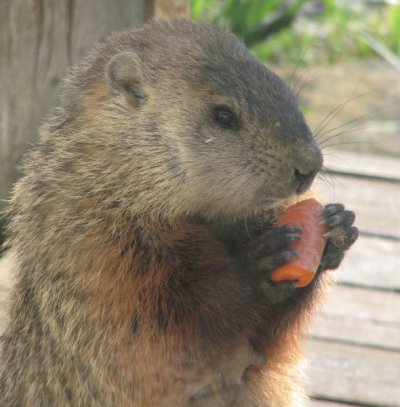
So, one forum I hang out on has a monthly challenge for photography. There aren't many of us, but it's a fun way push your technical skills. Well, my idea for this month's challenge won and I'm scratching my head for ideas.
This month's submission is 'Carrots in Odd Places'. Anything (clean, family-friendly) goes.
Here's my cheesy submission for last month's challenge on bokeh:
Are you planning to be financially independent as early as possible so you can live life on your own terms? Discuss successful investing strategies, asset allocation models, tax strategies and other related topics in our online forum community. Our members range from young folks just starting their journey to financial independence, military retirees and even multimillionaires. No matter where you fit in you'll find that Early-Retirement.org is a great community to join. Best of all it's totally FREE!
You are currently viewing our boards as a guest so you have limited access to our community. Please take the time to register and you will gain a lot of great new features including; the ability to participate in discussions, network with our members, see fewer ads, upload photographs, create a retirement blog, send private messages and so much, much more!
How about a carrot attached to the front of your car like a hood ornament? That'd be kinda odd, but slightly cool. Especially if you were a vegetarian who drove a semi.
The tip of this stump reminded me of a wolf howling. So, I breathed on the lense to give the illusion of fog and snapped away.
We were on our way to Custer State Park to check out the bison. The park ranger informed us that the Wind Cave herd (wild as opposed to branded and managed like in Custer) was on the move and near the road. We went down the road and were treated to 100+ bison moving from one side of the road to the other. This guy was actually only about 20 feet away... it's amazing; you can really appreciate how big and powerful they are at that sort of distance. It's almost hard to remember that they're wild creatures.
Last one, I promise.
This is looking down the Grand Canyon at sunset. I set my camera to expose for tungsten light which, in normal sunlight, will throw a blue cast over everything (poor man's blue tint filter). I was so proud of this shot for the longest time, until I saw a virtually identical shot on the DNR's site and at least one other virtually identical shot several other photographers. Nevertheless, it helped light that fire early on.
How about a carrot propped up on pillows in a really big bed? Like it's sleeping?
Or on a float in the middle of a pool or lying on a lawn chair or laying in a hammock? Used as a cue stick? I don't know...
Hey - what kind of camera do you have? I am somewhat of an amateur photographer myself, and I am about ready to upgrade. I'm thinking digital SLR, so any thoughts would be appreciated!
This is the kind of photography I'm interested in learning/doing when I RE. Any pointers you can share would be appreciated.
use it as a tool (dipped ink pen, band conductor's wand);
dress it up in doll clothes of a particular period in time
make it into a dug out canoe and float it
take a bunch of carrots, build a "log home" and put a rabbit in it (now there is one meaning for "eating you out of house and home"
__________________
I would not have anyone adopt my mode of living...but I would have each one be very careful to find out and pursue his own way, and not his father's or his mother's or his neighbor's instead. Thoreau, Walden
Carrot ideas: In a doll house in place of a doll? (If you had access to one). Tucked away almost invisible in a flower arrangement with many orange flowers. Or - right in the middle of a dozen roses. (Both would be better with greens still attached.)
I shoot a Canon 10D. My wife shoots a Canon 30D and I occasionally steal that one from her. We both shoot, primarily, with Canon's 28-135mm lense.
Rambling stream of thought follows....
I like the 30D a bit more than the digital rebel line. They're all fine cameras, but I think someone that's just starting out could keep from getting overwhelmed by the 30D while the Rebel will start to feel a bit limiting as time goes on.
Nikon has a fantastic line too but I'm not nearly as familiar with their equipment.
For a lense, I love the Canon 28mm-135mm f/3.5-5.6 IS USM. You can buy it from B&H or Amazon for just under $450. I love it so much that I bought my wife one for Christmas (her favorite lense now too). While it's not as nice as the pro glass, it's great for us amateur types. The IS stands for image stabilization. The same concept on Nikon's lenses is VR (vibration reduction). Basically, it allows you to shoot at a slower shutter speed without introducing camera shake (blurring because we all have the jitters).
The big secret to good nature photography is to not touch the camera. You want a shutter release (a basic corded Canon one is ~$70) and a good tripod. You don't need to spend a fortune on tripods and heads, but spend enough the first time (hint, don't buy these from Wal-Mart or Best Buy). Bogen / Manfrotto and Gitzo are both outstanding brands that you can't go wrong with. My wife bought me a setup that I never would have allowed myself to spend the money on and I can't imagine life without a solid tripod now.
One really cheap way to get into macro photography (like my fly picture or the first one, the grass picture) is to buy a close-up filter like the Canon 500D. This screws on the front of any lense (make sure you get the same size filter as lense). At ~$110, it's much cheaper than a dedicated macro lense (which comes with it's own advantages and drawbacks).
For an intro 'what do I buy and how do I take good shots', I'd highly recommend The Digital Photography Book by Scott Kelby. He has a wonderful writing style (think, talking with a good buddy not listing to someone pontificate). The book is a buying list with options (if you are on a budget then get this, if you can afford it get this, if you have so much money you don't care then get this... if you shoot this way, get this) and also wonderful tips and tricks for getting solid pictures. He doesn't go into the whys, just the hows.
For a great intro on composing great pictures, check out anything written by John Hedgecoe. I especially enjoy 'The New Manual of Photography' and 'John Hedgecoe's New Introductory Photography Course'. You're not going to get as much detail as more formal training, but you'll at least get enough information to know why composition matters.
Another great resource is the local community college. The one by us offers an associates degree in photography and, more importantly, has some great introductory courses on 35mm SLR camera operation (by extension, digital cameras) and composition.
My best advice though is to just get out and shoot, a lot. Play with every setting and see how each change affects your final product.
I don't keep up on the latest camera gear, but would be happy to try and answer any questions... including why someone might want a larger sensor like on the 5D or why someone might be happier with a 30D or Digital Rebel.

Thanks for the ideas too! I especially like the one about the carrot on the hood of the car (not sure if I can pull it off, but I'm thinking something similar to a hunter coming back from the woods... maybe a farmer coming back from the field, successful with the day's kill)
A carrot in with the roses would be great too. One of the local shops has some wonderful orange roses right now. That might be a pretty easy shot to pull off too.
Thanks for the ideas too! I especially like the one about the carrot on the hood of the car (not sure if I can pull it off, but I'm thinking something similar to a hunter coming back from the woods... maybe a farmer coming back from the field, successful with the day's kill)
There was a Far Side cartoon about early vegetarians returning from the hunt: six cave men bearing a huge carrot.
__________________ "Knowin' no one nowhere's gonna miss us when we're gone..."