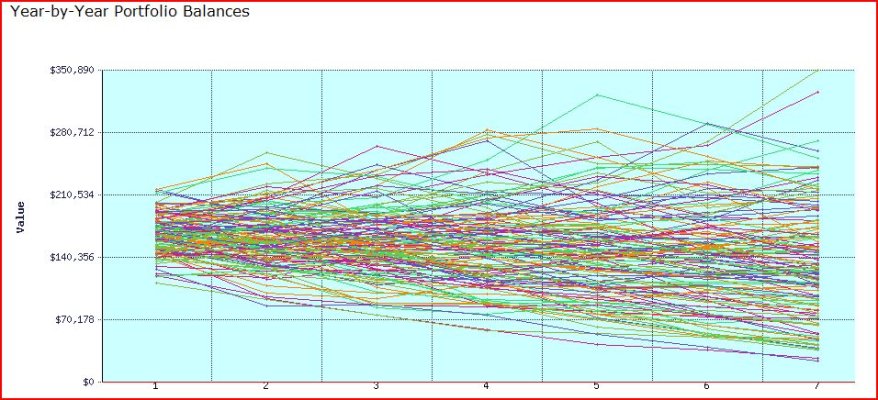
![]() |
|
|
|
#41 |
|
Give me a museum and I'll fill it. (Picasso)
Give me a forum ... ![]() ![]() ![]() ![]() ![]() ![]() ![]() Join Date: Dec 2003
Location: Losing my whump
Posts: 22,527
|
Should I have put three "winkies" at the end to avoid the lack of politeness comment?
We DID put together an entire section on frequently asked questions, and this item has about 20 threads with a few thousand posts attached. But frankly I dont expect people to read them before asking questions. Its inconvenient. In the meanwhile, your return from your long term bonds, adjusted for inflation, will be far less than 6%. You'll be lucky to get 3.5%. In fact, at that price point I'd buy them. Otherwise I wouldnt touch long term bonds with a 42' custom made pole. I'm not even thrilled with intermediate term bonds in the sort of market we've had for the last 8 years or will have for the next 10-15.
__________________
Many an optimist has become rich by buying out a pessimist |
|
|
|
|
|
#42 | |||
|
Dryer sheet aficionado
![]() ![]() ![]() Join Date: Nov 2007
Posts: 44
|
Quote:
Quote:
![]() Quote:
Ok so lets rap this up because I agree, it's not what the OP was talking about. |
|||
|
|
|
|
|
#43 |
|
Give me a museum and I'll fill it. (Picasso)
Give me a forum ... ![]() ![]() ![]() ![]() ![]() ![]() ![]() Join Date: Dec 2003
Location: Losing my whump
Posts: 22,527
|
Inflation for a non wage earner is a null effect. It applies to your debts and your investments equally. Wages are generally better offset than inflation...just not for the last 7-8 years
![]() Other than that, I accept your apology and I love you man!!! ![]() I'm not even remotely interested in thwarting repeated discussions if theres new and interesting elements to them. For what its worth, I get my ass kicked on a bunch of other discussion forums on a regular basis for not reading all 524,285 posts that went before. Its cultural. ![]()
__________________
Many an optimist has become rich by buying out a pessimist |
|
|
|
|
|
#44 | |
|
Recycles dryer sheets
![]() ![]() ![]() ![]() Join Date: Jun 2008
Location: Rochester, New York
Posts: 67
|
Quote:
When I was younger I had 40K that I wasted and should have put at least 20K of it into a gigantic payment and knocked down my mortgage balance. Today at 31 years old I'd pay off my house in a heart beat, no second thoughts. Your home is more than an investment, it's the roof over your head. You don't mess around with that. At no age would I have borrowed 100K at 6% to invest for a higher rate of return. A friend of mine and I did joke for a long time about taking out extra college loans at 4% to invest but did not see the sense in taking on additional debt. -Raymond |
|
|
|
|
|
|
#45 |
|
Full time employment: Posting here.
![]() ![]() ![]() ![]() ![]() Join Date: May 2008
Posts: 546
|
Hate to continue on a topic that is posted too often and takes over the board, but would like to add onto a comment that CFB made regarding social norms or whatever. I feel the reason that the mortgage debt and 6% interest is considered standard while borrowing at lower rates to earn higher rates isn't is simply because of the tangible and intrinsic value of a home. (I don't believe this, however, because money in essence is tangible and intrinsic in the fact that it can be exchanged for goods and services, so liquid investments, like stocks are after exchanging tangible assets, and could actually turn into a house... but I digress). Borrowing money at a standard rate so that people can have a roof over your head is a lot more socially understandable and accepted because:
a.) homeownership is an ideal many in this country think should be universal b.) not everybody trusts the stock market c.) everybody trusts the real estate market d.) sentimental/psychological value This is partly incorrect. Having $350,000 would be able to pay off that amount INDEFINITELY... and when the payments stop, you would still HAVE $350,000. Also, the $350,000 would grow with inflation and has no timeframe. Considering the amount you can make with other alternatives and the time frame involved with the payments, the value is a lot closer to 70k. At that rate, it seems there are 7 years left on this mortgage. Amortize an amount of money that pays off 70k in 7 years using money today that can be invested elsewhere and it will be around 100k. |
|
|
|
|
|
#46 |
|
Moderator Emeritus
![]() ![]() ![]() ![]() ![]() ![]() ![]() Join Date: Feb 2004
Location: Oahu
Posts: 15,734
|
I'm not sure what you mean by this...
__________________
* * For more info see "About Me" in my profile. |
|
|
|
|
|
#47 |
|
Give me a museum and I'll fill it. (Picasso)
Give me a forum ... ![]() ![]() ![]() ![]() ![]() ![]() ![]() Join Date: Dec 2003
Location: Losing my whump
Posts: 22,527
|
Pretty sure the value of the $350k would be reduced by inflation over time, not grow with it, unless you invested in TIPS.
This is why the 'conventional wisdom' of owning a mortgage being beneficial because the mortgage dollars get degraded by inflation doesnt work for an early retiree. A wage earners salary usually gets adjusted upwards to match or exceed inflation and create a positive imbalance, although that hasnt worked very well lately. An early retiree living off of a portfolio gets devalued by inflation at the same rate as the mortgage money thats been loaned to you and any adjustments to that have to come out of your investment returns. Of course, if you have an inflation adjusted guaranteed pension, then you look like a wage earner and you can use the inflation leverage.
__________________
Many an optimist has become rich by buying out a pessimist |
|
|
|
|
|
#48 | |
|
Full time employment: Posting here.
![]() ![]() ![]() ![]() ![]() Join Date: May 2008
Posts: 546
|
The real estate market going down is a national crisis because prices can only go up... according to mainstream media and the minds of millions of Americans. Thus, borrowing money to ivnest in the real estate market is much more comonly accepted.
Quote:
|
|
|
|
|
|
|
#49 |
|
Recycles dryer sheets
![]() ![]() ![]() ![]() Join Date: May 2006
Posts: 114
|
Money that is earmarked to pay the mortgage should not be invested in the stock market IMHO. I know of no place where I can get a guaranteed return of 5.875% except by paying off my mortgage, not to mention the much discussed intangible benefits. By paying off my mortgage, I can afford to be more aggressive in investing the $350K than I would otherwise be comfortable with.
|
|
|
|
|
|
#50 | |
|
Full time employment: Posting here.
![]() ![]() ![]() ![]() ![]() Join Date: May 2008
Posts: 546
|
Quote:
What I mentioned there was the 4% SWR assumes that you advance past what you are taking out each year to keep up with inflation and maintain your cash balance at the end. Assuming that this is a fixed mortgage, I can do some calculations. Taking your 1168 a month on $70k I will assume there are 6-7 years left, let's just say 7 for argument's sake. I will assume you will make 7% too, perhaps not a perfect assumption, but nonetheless acceptable. If you start with $77,563 and earn 7% a year, you will be able to pay off the $14,016 each year by taking out of your principal (For example, first year you earn $5,429 appreciation and sell off $8,586 of your principal to make the payments leaving you with $68,976. The next year you make $4,828 appreciation and have to sell off $9,187 of your principal leaving you with $59,789... math works, maybe not 100% possible to do with the real world so just add a couple thousand on to the end result). Thus, saying that $350,000 is equal to your mortgage payment cash flow I think is misleading due to the fact that at the end you will have nothing leftover... so an amortization type calculation is necessary. |
|
|
|
|
|
|
#51 |
|
Give me a museum and I'll fill it. (Picasso)
Give me a forum ... ![]() ![]() ![]() ![]() ![]() ![]() ![]() Join Date: Dec 2003
Location: Losing my whump
Posts: 22,527
|
Actually the 4% scenario doesnt specify maintaining your cash balance, it just specifies not going to zero during the period of time being tested. In many instances of trial runs a portfolio may become extremely depleted during or towards the end of a 'run'.
The strategy sounds terrific if you get a fixed rate of return, but returns are variable and multi year periods of negative returns are very common. If you took out your mortgage in late 99 or 2000 with this strategy, I'm thinking it hasnt worked out very well for you over the last 8-9 years. I'd have been chugging down antacid pills by late 2002. You could have taken on a whole lot more risk, or done a whole lot more diversification than most people and maybe pulled a positive return. But thats a whole different ball of wax. Once you risk adjust and take into consideration the odds of having a failure to produce a positive return for these less than ten year periods, you find there are no free lunches.
__________________
Many an optimist has become rich by buying out a pessimist |
|
|
|
|
|
#52 | |
|
Moderator Emeritus
![]() ![]() ![]() ![]() ![]() ![]() ![]() Join Date: Feb 2004
Location: Oahu
Posts: 15,734
|
Quote:
Admittedly the math gets a little hairier if the mortgage money went to Adelphia, Enron, Worldcom, & Global Crossing...
__________________
* * For more info see "About Me" in my profile. |
|
|
|
|
|
|
#53 | ||
|
Give me a museum and I'll fill it. (Picasso)
Give me a forum ... ![]() ![]() ![]() ![]() ![]() ![]() ![]() Join Date: Dec 2003
Location: Losing my whump
Posts: 22,527
|
Quote:
Further, resiliency depends more on the spending side than the investment side when things turn south. Someone with no debt isnt required to spend a penny they dont want to, short of anything that gets their home or freedom revoked. Market goes down 80%, that mortgage payment still needs to be made. Quote:
Havent we heard enough about how those havent gone anywhere (or are still underwater as in the case of the nasdaq) over the last ~10 years? If you were in REITS, certain high bond/low equity balanced funds, emerging markets or one of another handful of "right place at the right time with absolutely no way of foreseeing that they'd perform the way they did" asset classes, then you did well. In most cases, those asset classes are at the upper end of the risk spectrum.
__________________
Many an optimist has become rich by buying out a pessimist |
||
|
|
|
|
|
#54 |
|
Recycles dryer sheets
![]() ![]() ![]() ![]() Join Date: Jun 2006
Posts: 257
|
It seems to me that we can drive ourselves nuts running the numbers on this but what it really comes down to is our own personal feelings about debt. Many here think any debt including a mortgage a mistake. To many others a mortgage is okay and all other debt a mistake. Many others here are generally comfortable with consumer debt. When we made our last mortgage payment in 2002 we considered that a mortgage had done good for us overall and contemplated the possibility of moving into a larger and nicer house with a new mortgage or even a new mortgage on this house so that we could invest the money. In the end our strict "any debt is bad debt" mentality won out and we have lived debt free since then. It seems like the right way to me but may not seem so right to someone with a different outlook on debt.
Jeff |
|
|
|
|
|
#55 | |
|
Full time employment: Posting here.
![]() ![]() ![]() ![]() ![]() Join Date: May 2008
Posts: 546
|
Quote:
To CFB, while it is true that it only guarantees that it doesn't go to zero, if you make safer assumptions regarding a shorter time period (like I did in my example with 7 years and 7%), it is safe to say that the actual value of the fixed payment is a lot less than $350,000. Moreover, the $350,000 4% rule is designed so that it could grow and shouldn't fail over time periods involved. It could go down, but it could also go up in a similar manner. The idea being that the amount taken out is generally good enough to keep up with inflation and that you have money leftover when these payments are done. |
|
|
|
|
|
|
#56 |
|
Give me a museum and I'll fill it. (Picasso)
Give me a forum ... ![]() ![]() ![]() ![]() ![]() ![]() ![]() Join Date: Dec 2003
Location: Losing my whump
Posts: 22,527
|
Another fallacy. You have to deduct the standard deduction from the interest deduction calculation, since you'd probably be using that without a mortgage.
That $10,700 for a married couple filing jointly is a big initial hurdle to jump over and it'd be a pretty big mortgage to get significantly over that much interest. Plus in the later half of a mortgage, the interest "benefit" would decline significantly. Then theres the part about how this works as a retiree living off of portfolio withdrawals. You have to withdraw the money and pay taxes on it to then get the net deduction of the standard deduction minus actual interest paid. So you'd be paying more in taxes to withdraw the money to pay the loan than you'd be "getting back". Like I said, works great for an accumulating worker or a retiree with a big inflation adjusted pension. Takes a lot of bad math to make it "work" for an early retiree. Which is probably why 80-something percent of ER's dont have a mortgage. Not sure where you're going with the firecalc thing. The point is that many runs produce an increased result, many produce a decreased result, and some end up in the same place at the end as the start. To get a 7% return you'd have to take some risk. The level of risk determines the potential for gain and loss. The 4% SWR is not a principal maintenance plan, its a "can I get to the finish line without going broke" plan. The problem with a fixed calculation is that it doesnt measure the sale of depreciated shares during market down periods. Those shares are no longer there to participate in any ensuing recovery. You dont need calculators, percentages or any in depth thinking to take a good look at how this can work in real life. Average fixed mortgage rates over the last ten years have been running between 5 and 6%. Yeah, I know, some people got a rate better than that. It wasnt available to 99.7% of the rest of the population. Looking at vanguards 10 year annualized returns, the only funds that cleanly exceeded the mortgage costs are in the aggressive domestic equities, sector, and the more aggressive international categories like emerging markets and the international explorer fund. So by taking on a substantial risk, you could have made money. No surprise there. You also enjoyed a ton of volatility and had to stick with those funds through the ten year period. A few of the balanced funds made it into the 6-7% range. If you had chosen those funds you'd have eked out maybe a percent or two after taxes. Then you look at the yearly returns for all the funds through that ten year period. There were a ton of negative numbers across almost all the funds from 2000-2003, and there'll be some more this year. Did you sit pat for 3-4 years while seeing 5-25% drops and stay with your plan or did you eat the loss for a year or two and then bail, only to miss the 2003-2005 recovery? Basically if you picked a lower volatility, safer set of investments, you really wouldnt have gotten much out of it. If you went higher on the risk scale you'd have felt like an idiot and kicked yourself from 2000-2003, felt like a genius from 2003-2005, and you feel like an idiot again this year. I hate plans like that.
__________________
Many an optimist has become rich by buying out a pessimist |
|
|
|
|
|
#57 |
|
Full time employment: Posting here.
![]() ![]() ![]() ![]() ![]() Join Date: May 2008
Posts: 546
|
For the tax deductibility of mortgage interest, what you said is true, but if you itemize other taxes such as property tax (which you will probably have since you are paying mortgage on a house), state tax and sales tax, then it may not deduct the entire mortgage amount, but it will still de |