What does the curve look like of portfolio size versus the length of time for which it's required?
If you're going to retire for one year (say you plan on shooting yourself at the age you'll reach in a year), you can safely withdraw 100% of your portfolio and spend it on what you like, with no consequences. If you're going to retire for a thousand years (say you believe that ever-advancing developments in science and technology will allow you to live that long), you can withdraw basically all of your expected returns, since even a tiny compounding return will leave you mind-bogglingly wealthy in a thousand years, and over that much time you don't have to insure against a recession since you know you'll make it back in not too long (assuming you've got enough to live comfortably during the recessions, which you can easily do, and you automatically will after the first few decades or whatever). It's only within certain time frames that you really worry about insuring against retiring into a recession, and therefore need to limit your SWR by a few percentage points.
Might there be at least a percentage point difference in SWR between someone retiring in his or her 50's, compared to someone retiring in his or her 30's? (There also may be a significant difference in expected lifespan between someone born in the 1950's and someone born in the 1970's.)
Anyone have further influences on withdrawal rate versus retirement time, and does anyone want to describe what the curve will look like?
Edit: Changed "retire in one year" and "retire in a thousand years" to "retire for..." Oops, I was kind of distracted with work while I was writing this.
To paraphrase the question - What is the life expectancy normalized SWR ?
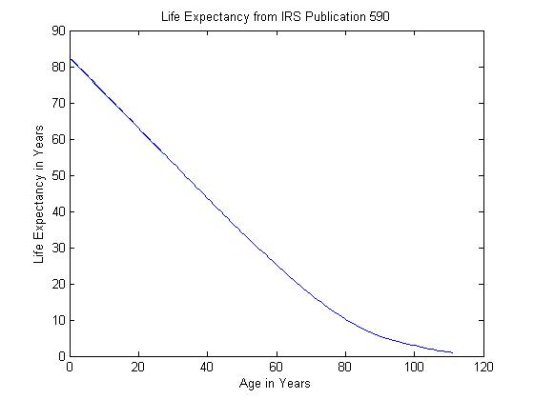
Here's on estimate of life expectancy versus age from the IRS.
Clearly if you are 78 years old, you needn't plan for a 30 or 40 year retirement.
I'd say that maybe you should plan to live to 90 or 100 years old and then use that timespan in Firecalc for the analysis. The longer the timespan then the greater the risk of one day going bust and hence the small the SWR will be.
There is some risk here in that if you pick too long of a lifespan (for you) then your SWR will be too small and you will have missed out on the potential richness that extra spending could give. If you pick too short of a lifespan then you risk going broke in your old age.
If you'll get SS for almost all of your retirement, then you can expect a much higher SWR, especially is SS will be a big part of your total spending plans. If you're in your 30s, you'll have a 30+ year period of no SS, and accordingly much higher withdrawals than if you had SS immediately.
I'm sure a few simple firecalc runs will give a quick answer, but it's something like 4% for a 30 year retirement and with the SWR decreasing ~0.1-0.2% for each additional decade. So for a 35 year old planning a 60 year retirement (bullet at 95), maybe 3.5%? The new firecalc seems to give slightly lower SWR's than the old Firecalc for some reason, so these #'s may be off. In theory, at some point you reach an asymptotic lower limit on SWR's as you stretch your withdrawal period out to "forever". So, yes, it may be prudent to knock a half percent or a percent off the withdrawal rate. At some point you're getting close to the dividend/interest yield (wellington/wellesley) and you might as well just spend whatever that % is (3-4.5% right now?).
Anyone have further influences on withdrawal rate versus retirement time, and does anyone want to describe what the curve will look like?
I guess the indefinitely safe SWR would be the equity premium.*
Maybe another conservative approach would be to live on the dividends from an all-equity portfolio (because nothing less has historically beaten inflation) while dipping into a portion of the portfolio's gains once in a while.* Since we wouldn't care about volatility, we wouldn't have to worry about bonds or other diversifiers like commodities & beaver cheese.
A less conservative approach would be to have a bare-bones budget equal to your annuitized cash flow (from Social Security or an annuity or perhaps even a govt pension) and merrily chew into the principal at a consumption rate for your lifespan... or the combined lifespan of you & spouse.* Then if you outlive your portfolio you can always take comfort in being able to subsist for the rest of your life on SS & Medicaid!
The problem with the expected lifespan number is that it's a median-- and you don't know which side of it you'll fall on.* It's certainly highly unlikely that you'll fall ON the median.
Quote:
Originally Posted by Cool Dood
I think this was my first on-topic post here. And it only took 556 posts to get to it!
Well, you're going to have to cut that out.* You didn't get to 556 posts by staying on topic, and you're not going to get another 556 posts anytime soon without a few kayaks!
__________________ *
*
For more info see "About Me" in my profile.
If I am understanding your question, my calculations and assumptions convince me that once you get out to 30-35 years, the deal becomes self-perpetuating. That is, if 4% SWR gets you out that far, it is probably almost good for eternity.
I think that the volatility gets smoothed out over long periods (as opposed to shorter periods where the risk of depletion in any given year is worth considering).
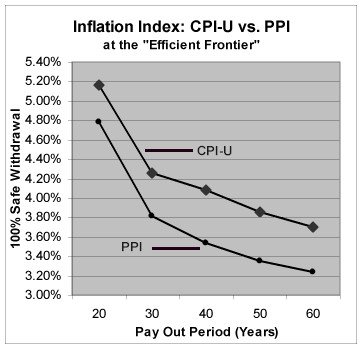
Look at the slopes of the curves - they are flatter and flatter, if not asymptotic, by 40 years.
__________________
Rich
Tampa, FL (ESR-bound. Really. I mean it. Seriously.)
As if you didn't know..If the above message happens to contain medical content, it's NOT intended as advice, and may not be accurate, applicable or sufficient. Don't rely on it for any medical purpose whatsoever. Consult your own doctor for all medical advice.
Look at the slopes of the curves - they are flatter and flatter, if not asymptotic, by 40 years.
Looking at masterblaster's graph, it looks like my original supposition was confirmed - adding a decade to the withdrawal period decreases the SWR by ~0.1-2%.
Looking at a numerical example: If I desired a $50,000 inflation adjusted withdrawal, I'd need $1,266,000 at 3.95% SWR. Say I add 10 years to my withdrawal period and assume conservatively the SWR goes down to 3.75%. Now I need a $1,333,000 nest egg. That means to last an extra 10 years, I have to save an extra $67,000, or 5.2% more.
The implications of this are that one can fairly easily/cheaply cover an extra decade or two of life expectancy. It also shows that it doesn't take too much more to have a 60 year withdrawal period than it does a 30 year withdrawal period. My back of the envelope calculations show that you need to increase your nest egg by approximate 1/2 of a percent for each additional year of the withdrawal period above 30. To go from 30 years to 60 years, this means about a 15% increase is required. (These numbers don't consider pensions, annuities, or SS, all of which will greatly change these numbers).
Give me a museum and I'll fill it. (Picasso) Give me a forum ...
Join Date: Dec 2003
Location: Losing my whump
Posts: 22,526
Quote:
Originally Posted by Nords
Maybe another conservative approach would be to live on the dividends from an all-equity portfolio (because nothing less has historically beaten inflation) while dipping into a portion of the portfolio's gains once in a while. Since we wouldn't care about volatility, we wouldn't have to worry about bonds or other diversifiers like commodities & beaver cheese.
Sounds like a familiar strategy
That beaver cheese is sure starting to tempt me though...is that a salty cheese by the way?
__________________
Many an optimist has become rich by buying out a pessimist